Rochester Water Damage Restoration
Everyone in Rochester promises a 45-minute response. Nobody tells you the price.
You're standing in it right now, so here's the short version: the water damage is probably covered by your insurance. The invoice is the part that goes wrong. Call now and get a ballpark for your situation — or read the real Rochester cost ranges first. Both are free.
- Real Rochester cost ranges, published
- Equipment-day billing explained
- No obligation, 24/7

5 things to do right now
- Kill the power to the affected area at the breaker — don't walk into standing water to reach a switch. If the breaker panel itself is in the flooded area, don't reach it: call your utility or an electrician.
- Find the shutoff. Main valve for a supply line; for groundwater or sewer backup there's nothing to shut — move to the next step.
- Photograph everything before you touch it. Wide shot of each room, then close-ups. Your insurer will ask, and these photos are what protect you later if the scope of work grows.
- Don't run a household fan on sewage backup. Category 3 water aerosolizes. Fans make it worse, not better.
- Write down the time you found it. Drying timelines, mold questions, and your claim all date from this moment.
Not sure what you're looking at? Call and describe it — that part costs nothing.
Call (866) 332-0750Water Damage Restoration in Rochester, NY
Water damage restoration in Rochester covers three jobs that get billed as one: getting the water out, drying the structure down to the framing, and repairing what the water ruined. Most Rochester homeowners meet all three on the same invoice and can't tell where one ends and the next begins.
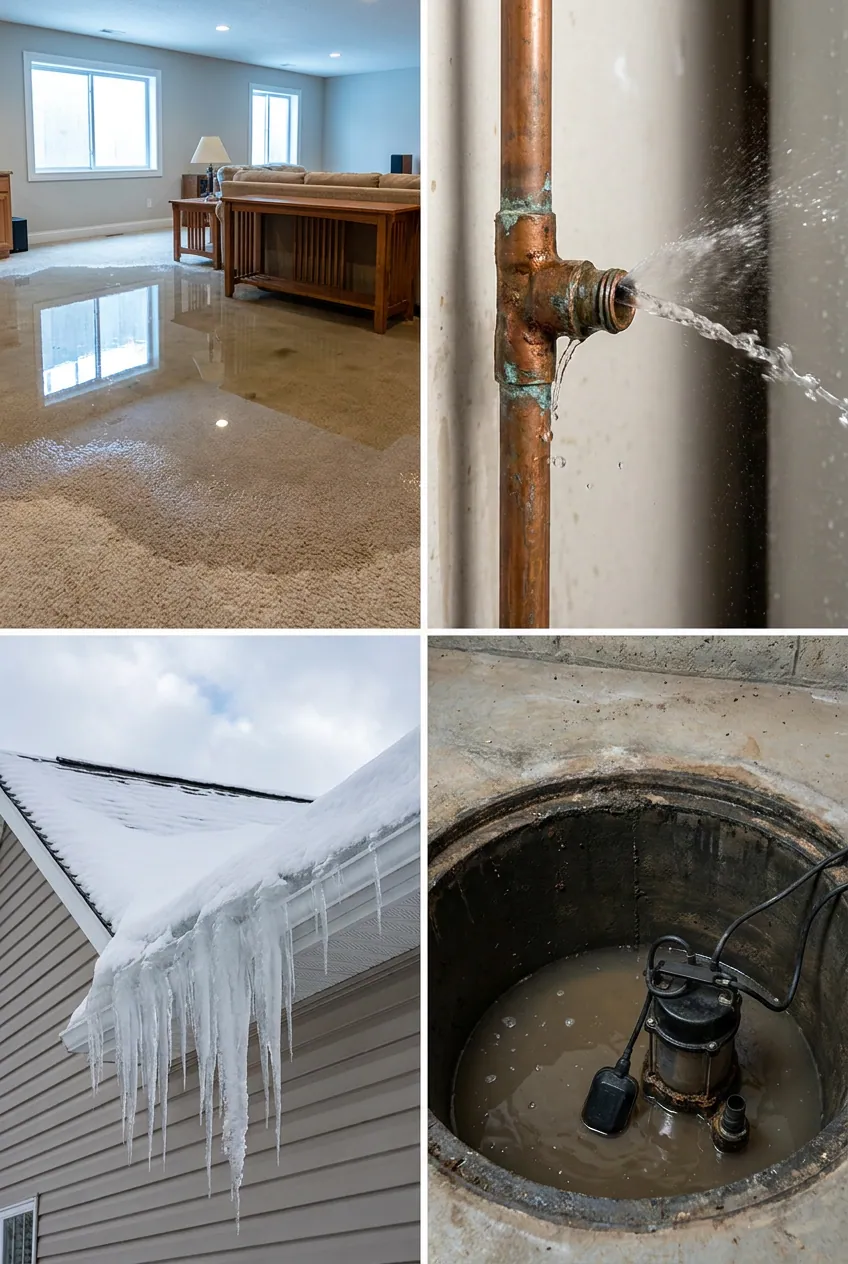
That matters more here than in most markets. Rochester's freeze–thaw cycle means our water damage arrives in seasons — burst pipes and ice dams from December to February, snowmelt against the foundation in March and April, storm and sewer backup through the summer. A finished basement in a 1960s Rochester house takes water differently than a slab house in a warm market, and the drying plan is different too.
This page publishes what the work costs in Rochester, how the billing actually works, and what to ask before you sign. It's the part nobody hands you at 7am.
Extract
Standing water out. Hours, not days — this is the fastest part of the job.
Dry
Air movers and dehumidifiers until moisture readings hit target. This is where the invoice is decided.
Repair
Replace what came out — drywall, carpet pad, insulation. Often a separate line, sometimes a separate contractor.
Water Damage Services Across Rochester
What Water Damage Restoration Actually Costs in Rochester
Nobody except us will give you a number. Here is what you can expect.
| Job | Typical Rochester range | What moves it |
|---|---|---|
| Flooded basement, clean water, unfinished | $1,200 – $4,000 | Square footage, how long it sat |
| Flooded basement, finished | $3,500 – $12,000 | Whether drywall and carpet come out |
| Burst supply pipe, one or two rooms | $2,500 – $7,000 | How far the water traveled |
| Ice dam ceiling leak | $2,000 – $6,000 | Insulation saturation, ceiling replacement |
| Sewage backup (Category 3) | $4,000 – $15,000 | Contamination protocol is non-negotiable |
Four things move that number, in order:
- Water category. Clean supply-line water is cheapest. Grey water (appliance, shower) costs more. Black water — sewage, groundwater, anything that sat long enough to grow — triggers a containment protocol that roughly doubles the job.
- Square footage of affected material, not room size. Water wicks up drywall. The wet zone is usually bigger than it looks.
- Time. Every hour raises the odds that drying becomes demolition.
- What comes out. Drywall, carpet pad, insulation, and cabinet kickplates are the usual casualties. Removal is where the price steps up.
These are our usual market ranges for jobs like yours in Rochester — not a quote, and not a fixed price. Fixed price is set when we see your situation in person. The point of publishing this is that you should walk into that conversation already knowing the shape of the number.
How Rochester Homes Take On Water
Flooded basements are the most common water damage call in Rochester, and the most seasonal. Spring snowmelt saturates the ground, hydrostatic pressure builds against foundation walls, and water finds the cracks. Sump pump failure turns a manageable spring into a flooded basement overnight — and Rochester's older housing stock means a lot of pumps are one storm from retirement. Clean groundwater in an unfinished basement is the cheap end. A finished basement is where it gets expensive: carpet pad holds water, drywall wicks it up the wall, and the framing behind it has to be dried in place or opened up. The decision to open the wall is the single biggest fork in the invoice — ask whoever comes out to show you the moisture readings behind it before they cut.
Burst pipes are Rochester's winter signature. Water expands as it freezes, the pipe splits, and it often doesn't announce itself until the thaw — which is why the burst you discover in February may have been failing since December.
Ice dams are the one most Rochester homeowners misread. Snow melts off a warm roof, refreezes at the cold eave, and the dam pushes water backward under the shingles and into the ceiling. The stain on your ceiling is a roof problem wearing a plumbing costume. Restoration dries it; it doesn't fix the cause.
Sewage backup is the one to stop reading about and call about. Category 3 water carries pathogens, and the cleanup protocol — containment, removal of anything porous it touched, antimicrobial treatment — is not a DIY job and not a job for a general handyman.
Equipment Days: The Line Item That Decides Your Invoice
Here's the mechanic nobody explains.
After the water is out, drying is done with air movers (high-velocity fans) and dehumidifiers. They are billed per unit, per day. Not per job. That means two variables set the drying half of your invoice: how many units get placed, and how many days they stay.
Rough shape of a normal placement: roughly one air mover per 10–16 linear feet of wet wall, plus one per affected room corner, plus a dehumidifier sized to the cubic footage. A standard wet Rochester basement is often somewhere in the 4–8 air mover range with one or two dehumidifiers. Typical drying runs 3–5 days.
6 air movers × 4 days
10 air movers × 7 days
What keeps it honest
- Ask for the moisture readings — the target, and today's number. Drying ends when the material hits target, not when the calendar says so.
- Ask for the equipment count in writing before it's placed.
- Ask what changes the day count, and get the answer before day one rather than on day six.
- Ask to see the readings each day. A contractor drying properly will be glad to show you. That reaction tells you a lot.
None of this makes you a difficult customer. It makes you a customer who is counting.
Water Damage Restoration FAQs
How much does water damage restoration cost in Rochester?
Most Rochester jobs land between $1,200 and $15,000, depending on water category and how much material has to come out. A clean-water unfinished basement is the low end; a finished basement or a sewage backup is the high end. The ranges above break it down by job type.
Will my homeowner's insurance cover water damage in New York?
Usually yes for sudden and accidental damage — a burst pipe, an appliance failure, a storm. Usually no for groundwater and surface flooding, which needs separate flood coverage, and no for damage traced to long-term neglect. Photograph everything before you touch it; that documentation is what claims turn on.
How fast does mold actually start after water damage?
Mold can begin colonizing in about 24 to 48 hours in the right conditions. That's a real clock, not a sales tactic — but it's also the lever used to rush you into signing. Both things are true. Move quickly and still ask for the scope in writing.
How long do the fans and dehumidifiers have to stay?
Typically 3 to 5 days, until moisture readings hit target — not a fixed number of days. Because equipment bills per unit per day, this is the line item most worth asking about. Ask for daily readings.
What areas around Rochester do you cover?
Rochester and the surrounding Monroe County towns — Greece, Irondequoit, Webster, Penfield, Henrietta, Brighton, Pittsford, and Fairport. Call (866) 332-0750 and describe your situation.
Get a number for your situation
You've now read more about how this is billed than most people learn during the entire job. Call and describe what you're looking at — the water category, roughly how much floor, and how long it's been sitting. That's enough for a real range.
- (866) 332-0750
Fastest — 24/7, no obligation - Rochester, NY
- Available 24/7 — water damage doesn't keep hours